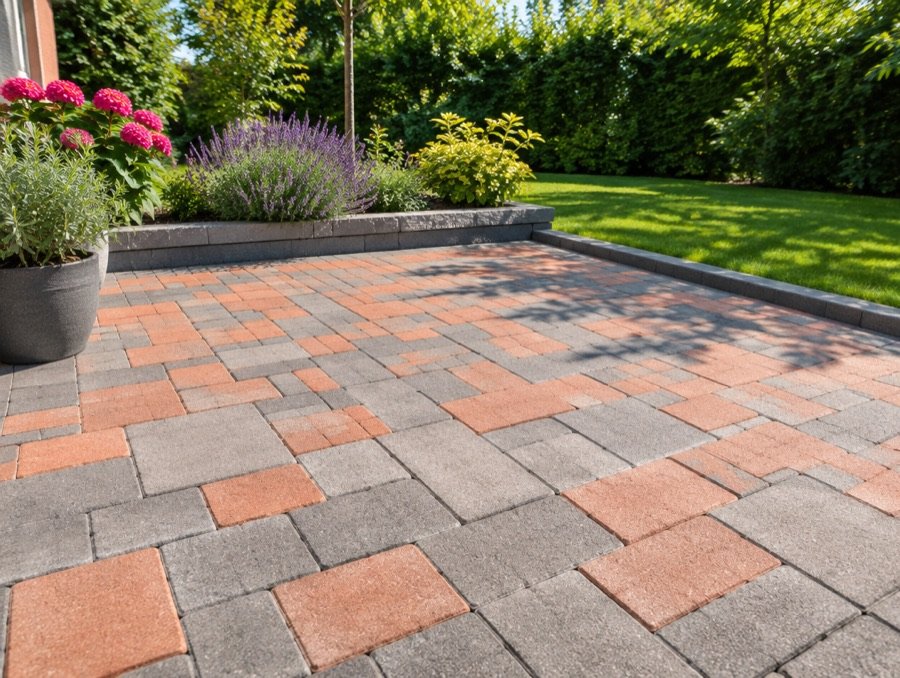
How many bags of polymeric sand per square foot of pavers?
The manufacturer data sheets we read give the same coverage for a 50 lb bag: 60 to 120 sq ft with narrow joints, and 25 to 40 sq ft with wide joints. The sheet also says the quantity depends on the shape and size of the pavers and on the width and depth of the joints. There is no single number, so work from a range and round up.
The formula is: bags = area in square feet / coverage per bag. Because the range is wide, calculate both ends. For a 12 x 16 ft patio (192 sq ft) with narrow joints: 192 / 120 = 1.6 bags at the best case and 192 / 60 = 3.2 bags at the low end, so buy 2 to 4 bags. If your joints are wide: 192 / 40 = 4.8 and 192 / 25 = 7.7, so buy 5 to 8 bags.
What changes the number
Four things decide where in the range you land.
- Joint width: the paver spacer bars set the width, and ICPI says joints are typically 1/16 to 3/16 in. Wider joints take much more sand.
- Paver size: small pavers have more joint length per square foot. A 4 x 8 in. paver (about 4.58 per square foot) has far more joint than a 6 x 9 in. paver (about 2.67 per square foot), so small units pull coverage toward the low end.
- Joint depth: the data sheets set a minimum joint depth of 1.5 in. The paver thickness (2 3/8 in. or more) and the 1 in. bedding sand layer determine how deep the sand sits.
- Chamfers and texture: beveled or rough-edged units have more void to fill, and ICPI notes joints can be 1 to 2 mm wider for units with a stone-like finish and rough edges.
Polymeric sand requirements: when it is and is not right
The data sheet for the standard product says it fits joints from 1/16 in. to 1 in. (ideal 1/16 to 3/8 in.) and is for sand-set pavers over a drainage base, not for submerged or constantly wet surfaces. For high-humidity areas, pool decks, very wide joints, steep slopes or heavy traffic, the manufacturer recommends a different, high-performance formula. A bedding layer that does not drain will trap moisture and stop the sand drying properly.
Mechanical compaction is mandatory. The sheet says failure to compact first may compromise joint integrity, so do not use it on pavers that have not been vibrated into the bedding sand. The ICPI tech note describes this as joint sand spread and compacted until joints are full, which may need two or three passes.
How to apply it
Use the order from the data sheet. Check the weather first: the surface and joints must be dry, the temperature above 32 F for 48 hours afterward, the sprinklers off, and no rain forecast for 24 hours.
- 1. Test a small hidden area of about 4 sq ft before starting.
- 2. Spread the sand over a small area and sweep it into the joints with a stiff-bristled broom.
- 3. Run the plate compactor over the area, then add more sand and compact again until a finger cannot sink into the joint.
- 4. Sweep off all excess and use a leaf blower so no sand dust is left on the paver faces.
- 5. Check that the sand sits at least 1/8 in. below the top of the paver or at the bottom of the chamfer.
- 6. Starting at the bottom of the slope, shower a section of about 200 sq ft for 30 seconds, wait, and shower again until water stops penetrating. Stop when there is no free water on the joint and the sand is activated to 75 percent or more of its depth. Over-watering lengthens curing.
Drying, traffic and sealing
The data sheet says the sand must dry fully before exposure to rain, 24 hours minimum, longer in cold, humid weather or with joints wider than 1/2 in. It can withstand unexpected rain after 60 minutes. Foot traffic is allowed immediately and vehicles after 48 to 72 hours. Limit pressure washing for 30 days, and wait for the joints to harden, typically about 30 days, before cleaning or sealing the surface.
Joints go soft when wet and harden when dry again, and moss, mold and mildew can grow where the surface stays damp, shaded or covered in organic debris. Keep the patio swept.
Buying and storage tips
Bags are 50 lb, and the pallet used by the manufacturer holds 56. Buy all you need in one go, because the sheet notes that color and grain size vary since it comes from a natural source. Unused bags can be stored outside only if they remain on a pallet and in the original packaging, so keep them dry.
Check the product label for coverage on your paver size, since ranges differ by formula. If the number falls on a bag boundary, round up: a spare half bag is cheaper than a second trip to the supplier.
Frequently asked questions
How much does one 50 lb bag of polymeric sand cover?
The manufacturer data sheets give 60 to 120 sq ft for narrow joints and 25 to 40 sq ft for wide joints. The right figure depends on paver size and joint width and depth.
How many bags for a 200 sq ft patio?
With narrow joints, 200 / 120 = 1.7 to 200 / 60 = 3.3, so 2 to 4 bags. With wide joints, 200 / 40 = 5 to 200 / 25 = 8 bags.
Do small pavers need more polymeric sand?
Yes. They have more joint length per square foot, so coverage falls toward the low end of the range. Wider joints also use more sand.
Can I use polymeric sand without a plate compactor?
The data sheet says mechanical compaction is mandatory and that skipping it may compromise the joint. The manufacturer points to a different product for joints wider than 1/4 in. where compaction is not possible.
How long before it rains can I apply polymeric sand?
Plan for 24 hours without rain. The sheet says it handles unexpected rain 60 minutes after installation, but it must dry completely and drying is slower in cold or damp weather.
When can I walk on it?
The data sheet says pedestrian traffic is allowed immediately, and vehicles after 48 to 72 hours.
Sources: Polymeric sand technical data sheet (manufacturer), coverage, joints, compaction and drying, Polymeric sand RG+ technical data sheet (manufacturer), CMHA Tech Note PAV-TEC-002-22, Construction of Interlocking Concrete Pavements, CMHA Tech Note PAV-TEC-005-22, Cleaning, Sealing and Joint Sand Stabilization, Unilock Hollandstone 4x8 product sheet. Read 7 November 2026.
What you will also need for pavers
Tools and supplies that go with this job. These are Amazon search links, so you can compare options and current prices there.
- Plate compactor rental accessories: hand tamper
- Edge restraint for pavers
- Screed rails and board
- Rubber mallet
- Paver cutting: masonry blade and dust mask
- Polymeric sand
As an Amazon Associate I earn from qualifying purchases. These are paid links and cost you nothing extra.