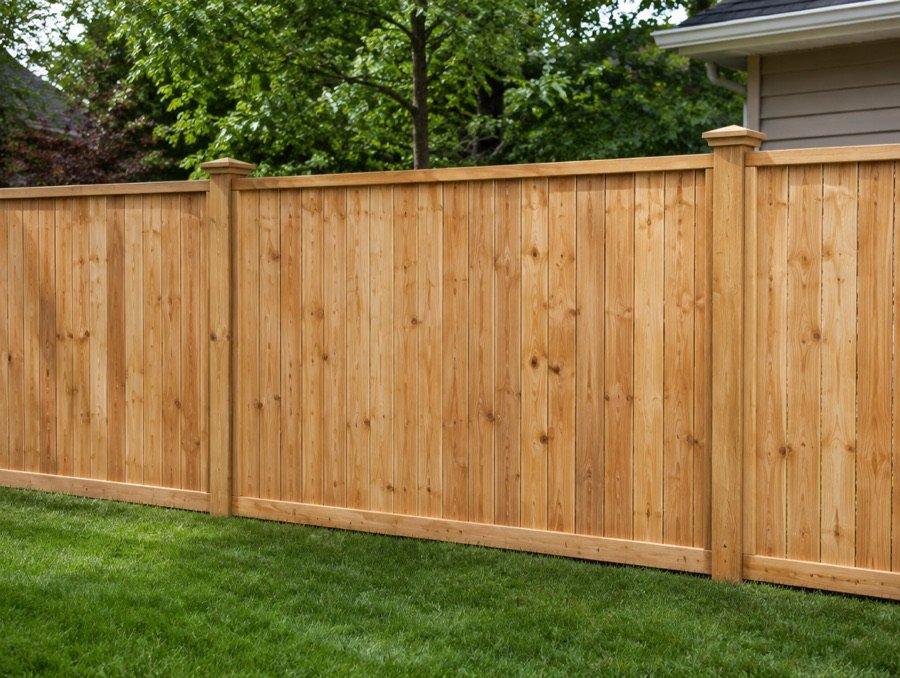
Sections and posts
A fence guide for redwood fencing, hosted by Home Depot, says posts should be no more than 8 feet center to center to suit 8 foot rails, and that 6 foot spacing is recommended for maximum strength. Divide your fence length by the spacing and round up for the number of sections. A straight run needs one more post than sections.
Worked example: 96 ft at 8 ft spacing is 12 sections and 13 posts. At 6 ft spacing it is 16 sections and 17 posts. Add a post for every gate and corner, and measure the gate opening separately.
Rails
The same guide calls for three horizontal rails per section on a 6 foot fence: a top rail about 6 inches below the top of the pickets, a bottom rail about 6 inches above the ground, and a middle rail centered. Its materials list uses 2 by 4 rails 8 feet long and 4 by 4 posts 8 or 10 feet long. For the example, 12 sections x 3 = 36 rails.
Pickets, with the maths shown
The guide uses dog-ear pickets that are 3/4 by 5.5 inches by 6 feet, spaced with a 1/8 inch gap. Each picket then uses 5.5 + 0.125 = 5.625 inches of fence length, so 12 / 5.625 = 2.133 pickets per foot. That is our arithmetic from the guide's dimensions.
For 96 ft: 96 x 2.133 = 204.8, so 205 pickets. Per 8 foot section it is 17.07, so 18 pickets, though the exact count depends on where you start and finish. Buy a few extra for cuts and warped boards.
Setting the posts
The guide says holes should be at least 2 feet deep or one third of the post length, about 10 to 12 inches wide, with a 4 inch gravel base. Check local rules for depth where the ground freezes. Many places limit fence height and require a permit, and your property line and utility lines must be located before you dig.
Common mistakes
- Forgetting the extra post at each gate and corner.
- Using 8 foot spacing with heavy pickets when 6 foot would be stronger.
- Not allowing for the gap: zero gap gives fewer pickets but they swell and cup as they dry or get wet.
- Digging without calling the utility locating service for your area.
How much for common fence lengths
Each row uses 8 ft post spacing, 3 rails per section and 5.5 in pickets with a 0.125 in gap. Gates and corners need extra posts. Change any number in the fence calculator.
| Fence | Sections | Posts | Rails | Pickets |
|---|---|---|---|---|
| 50 ft fence | 7 | 8 | 21 | 107 |
| 100 ft fence | 13 | 14 | 39 | 214 |
| 150 ft fence | 19 | 20 | 57 | 320 |
| 200 ft fence | 25 | 26 | 75 | 427 |
| 300 ft fence | 38 | 39 | 114 | 640 |
Frequently asked questions
How far apart should fence posts be?
No more than 8 feet center to center for 8 foot rails. Six feet is recommended for maximum strength, according to the redwood fence guide we used.
How many rails does a 6 foot fence need?
Three per section: top, middle and bottom.
How many pickets per foot of fence?
With 5.5 inch pickets and a 1/8 inch gap, about 2.13 pickets per foot.
How deep should the post holes be?
At least 2 feet, or one third of the post length, with a 4 inch gravel base, per the guide. Local frost depth may require more.
Does this work for a 4 foot or 8 foot fence?
The rail count of 3 per section is for a 6 foot fence. For other heights check the manufacturer's instructions.
Sources: Redwood fence installation guide (hosted by The Home Depot). Read 7 November 2026.
What you will also need for fence materials
Tools and supplies that go with this job. These are Amazon search links, so you can compare options and current prices there.
- Post hole digger
- Level and string line
- Exterior deck screws
- Fence post concrete mix
- Work gloves
- Tape measure
As an Amazon Associate I earn from qualifying purchases. These are paid links and cost you nothing extra.