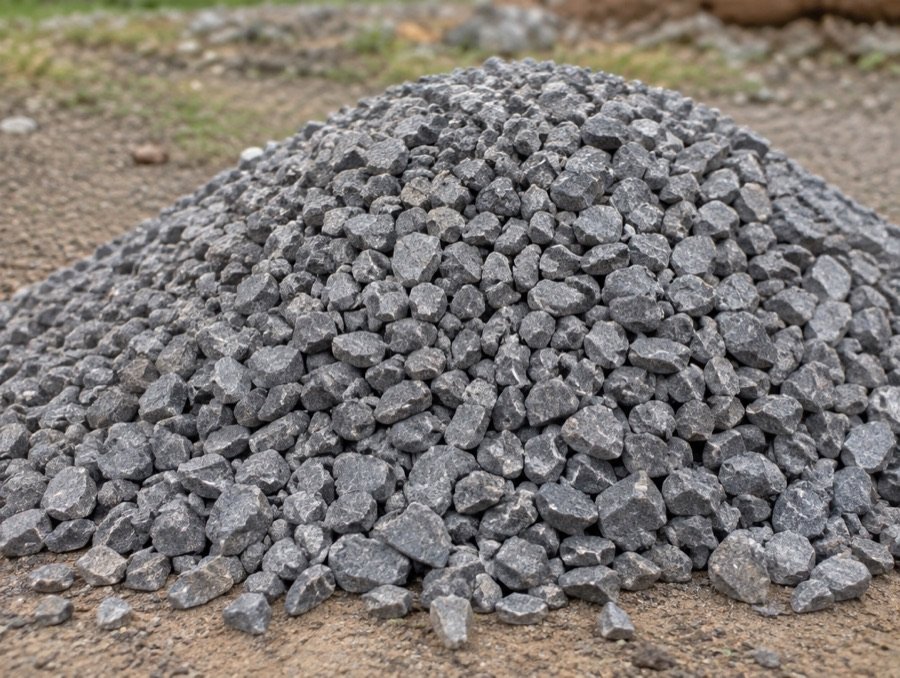
How much gravel you need for a driveway
Work in compacted depth first, then convert to what the truck will deliver. Multiply length by width in feet, multiply by the compacted depth in feet (inches divided by 12), and divide by 27 cubic feet per cubic yard.
Worked example: a 12 by 50 foot driveway built 6 inches deep when compacted. The area is 600 square feet. The volume is 600 x 0.5 = 300 cubic feet, or 300 / 27 = 11.1 cubic yards compacted.
Compaction squeezes the stone. The Washington State DOT estimating table (Design Manual M 22-01, Exhibit 620-1) lists crushed surfacing at 1.43 to 1.48 tons per cubic yard as measured in the truck and 1.85 tons once compacted. Dividing shows the stone loses about 20 to 23 percent of its volume when compacted, so you need about 25 to 30 percent more loose volume than the finished compacted volume. Penn State's engineered road stone behaves similarly: an 8 inch loose layer compacts to 6 inches. WSDOT also adds 10 percent for waste.
Continuing the example: 11.1 x 1.25 = 13.9 cubic yards loose, and 11.1 x 1.30 = 14.4 cubic yards. At about 1.4 tons per cubic yard loose, that is 19.4 to 20.2 tons, or roughly 21 to 22 tons with 10 percent waste. Cross-check: 11.1 cubic yards x 1.85 tons compacted is 20.6 tons before waste.
- 10 by 20 feet, 6 inches compacted: 3.7 cubic yards compacted, 4.6 to 4.8 cubic yards loose, 6.5 to 6.7 tons, or about 7.1 to 7.4 tons with waste.
- 12 by 100 feet, 8 inches compacted: 29.6 cubic yards compacted, 37.0 to 38.5 cubic yards loose, 51.9 to 53.9 tons, or about 57 to 59 tons with waste.
- Weight per cubic yard varies with the stone and its moisture; WSDOT tabulates dry weights and says to correct for water content, so ask your supplier for the real figure.
Choosing the right stone
A driveway needs stone that locks together, not stone that rolls. Vermont's Lake Wise guidance says round stone should not be used as packing gravel, uniform-size stone is not proper driveway gravel, and tires can roll rounded bank-run stones out of the surface, leaving holes that pond water. Correct gravel has packing dust and irregular edges that bind together. That rules out pea gravel and river rock for the driveway itself.
Fines, the dust-sized particles, are the balance to get right. Vermont says loose surface material generally means too few fines, while a soft driveway often means too many fines, a thin base, or a base sitting in the water table. Penn State explains the trade-off: clean, open-graded stone drains but does not compact into a dense mass, while well-graded stone with fines packs tightly but does not drain.
In practice, ask for well-graded crushed stone with fines for the base and 3/4 inch minus crushed stone for the top course (Vermont specifies 3/4 inch stones for the top layer). Local names vary: dense grade, crusher run, road base, or a state number such as Pennsylvania's 2A. See our comparison of pea gravel, crushed stone and road base.
What to buy
Buy by category and specification, not product name. For a driveway, bulk delivery is the only practical route: a 0.5 cubic foot bag means 54 bags per cubic yard.
- Base stone: crushed, angular, mixed sizes with fines, from a supplier who can name the gradation.
- Top-course stone: crushed 3/4 inch minus, ideally from the same quarry.
- Separation fabric (geotextile) for soft or fine-grained soil, woven or nonwoven, wide enough to overlap seams.
- A plate compactor with enough force for the lift thickness (ICPI says to check the manufacturer's minimum lift), or a rented roller for larger jobs.
- A steel landscape rake, string line, stakes and a long straightedge for setting the crown.
- Optional: perforated pipe and clean drain stone if you have springs or standing water.
Preparing the site, soft soils and geotextile
Strip sod and topsoil, shape the subgrade to the crown you want, and compact it. ICPI calls for the soil under a residential driveway to reach at least 98 percent of standard Proctor density, a contractor-level measurement; ICPI adds that soils that cannot reach it, or stay continually wet, may need stabilizing or drainage designed to remove the water.
A geotextile earns its cost on weak soil. The US DOT/South Dakota LTAP manual explains why: under traffic the surface flexes, and pressure pushes water and fine soil up into the new stone, making it weak and undrainable. A fabric separator filters out the fines while letting water through. Penn State advises covering separation fabric with at least 12 inches of stone, for example 6 inches of base stone under an 8 inch loose lift, and keeping the fabric edge at least 2 feet from the road edge so equipment cannot snag it.
For frost and wet ground we found no official frost depth for a gravel driveway. ICPI says base thickness may be greater depending on freezing temperatures and traffic. Wisconsin's road research center caps fines in granular base at 8 percent to promote drainage and reduce frost susceptibility, and the South Dakota manual suggests perforated pipe where springs feed the roadbed. Ask your county road department what local frost behavior to expect.
Step by step
This is the sequence for a standard two-lift build. The lift sizes are our working plan, built from the ranges in the next section.
- 1. Check for buried utilities, then stake the driveway outline and mark the center line.
- 2. Strip sod and topsoil, then shape the subgrade with the crown already in it. Penn State warns never to place stone on a flat surface or try to create crown by varying the stone depth.
- 3. Compact the subgrade. Fix soft spots with extra stone or drainage before going further.
- 4. Roll out geotextile over weak or fine-grained soil, overlapping seams and keeping the edge back from the driveway margin.
- 5. Cut a shallow key (a notch of about 3 to 4 inches, per Penn State) along each edge where possible, so the stone is supported rather than tailing off.
- 6. Spread the base stone evenly and compact each lift. ICPI puts minimum compacted lifts at 4 to 6 inches depending on equipment; slightly damp stone compacts more easily (Oregon State Extension).
- 7. Spread the 2 inch top course of 3/4 inch minus stone and shape it with Vermont's method: find the center, then drop 1/2 inch per foot to each edge.
- 8. Compact the top course and keep traffic off until it is dry, as Penn State does for new placements.
- 9. Walk it after the first heavy rain and fix ponding or ruts early.
How deep, in two lifts, and for which loads
The sources give ranges, not one answer. The ranges depend on the use:
- ICPI Tech Spec 10 (paver bases, a close cousin of a driveway base): minimum compacted aggregate base 4 to 6 inches for walks, 6 to 8 inches for driveways and 8 to 12 inches for streets, thicker for freezing conditions or heavy traffic.
- Penn State driving surface aggregate (an engineered road surface): a single 6 to 8 inch loose lift, compacted to about 4.5 to 6 inches. Under 6 inches loose may not compact properly; over 8 inches may not reach maximum density with a 10-ton roller.
- US DOT/South Dakota gravel layer table for new rural roads: for 0 to 5 heavy trucks a day, 4.5 inches on strong subgrade, 5.5 inches on medium and 6.5 inches on weak. At 5 to 10 trucks a day: 5.5, 7.0 and 8.5 inches.
- Our plan for cars on firm soil: a 4 inch compacted base course plus a 2 inch top course, 6 inches in all.
- Our plan for soft soil, regular heavy deliveries or frost-prone ground: 6 to 8 inches of base plus a 2 to 3 inch top course, with fabric underneath on fine soils.
Crown, drainage and edges
Water is what destroys gravel drives. Penn State's crown bulletin gives paved roads about 2 percent cross-slope (1/4 inch per foot) and says unpaved surfaces need 2 to 3 times that: 4 to 6 percent, or 1/2 to 3/4 inch per foot. The South Dakota manual calls at least 1/2 inch per foot ideal and warns that too much crown feels unsafe, especially in snow and ice.
On a 12 foot driveway the high point is 6 feet from each edge, so 1/2 inch per foot puts the center 3 inches above the edges. Keep shoulders at or below the surface: Penn State notes a shoulder only slightly higher can trap a lot of water.
Send runoff somewhere stable. Vermont recommends ditches on the uphill side, at least 2 feet wide and 1.5 to 2 feet deep, stone-lined over nonwoven fabric above 5 percent grade, and never channeling driveway runoff to wells, septic systems, wetlands or lakes. Where the drive meets existing pavement, Penn State advises a notch at least 4 feet long so the new stone ends flush rather than in a feather edge.
Common mistakes
- Shaping the drive flat or crowning it like pavement; Penn State calls this a common problem on unpaved surfaces.
- Using rounded stone, pea gravel or bank-run gravel as the surface.
- Spreading one thick, uncompacted layer instead of compacted lifts.
- Skipping separation fabric over soft clay or silt.
- Ordering the compacted volume without the loose-to-compacted allowance.
- Leaving a shoulder or sod edge higher than the stone.
- Ignoring a spring or downspout that dumps onto the driveway.
- Placing stone in freezing weather; Penn State's specification postpones placement if freezing is forecast.
Cost and ordering tips
Bulk stone is sold by the ton or the cubic yard; tons are more reliable because the scale ticket shows what arrived. Ask the supplier for the product name and gradation, whether it is crushed, whether it contains fines or is washed, its weight per cubic yard, truck size, and whether the truck can spread the load or only dump a pile.
Check access before ordering: a loaded truck needs firm ground. Splitting the order into base and top-course deliveries lets you compact one layer before the next arrives. We do not quote prices because they vary by region and haul distance; compare quotes per ton delivered for the same product.
Maintenance, regrading and top-ups
Penn State describes how a crown fails: traffic compacts the wheel tracks, windrows of displaced stone form at the center and edges, and fines are lost. The flat 'A' profile turns into a 'W', and water ponds and softens the surface. Regrading is routine, not a sign something went wrong.
Vermont suggests grading two to four times a year, in spring and fall, and replacing lost stone with quality crusher run that packs hard. At home that means raking windrows back toward the center, filling ruts and potholes soon after they form, restoring the crown, and clearing ditches. Top up thinly when the base shows through.
When to hire a contractor
A short, flat, well-drained parking pad on firm soil is a reasonable weekend job with a rented plate compactor. Hire help for a long or steep drive, soft clay or silt, a spring or ditch crossing, or a site near a lake, stream or wetland (Vermont's guidance exists because driveways there carry sediment to water). Penn State's engineered surface calls for a motor-paver and a 10-ton vibratory roller, and the South Dakota manual recommends a professional engineer for final thickness decisions. Also ask your town or county whether the connection to a public road or a culvert needs a permit; we found no national rule.
Common gravel project sizes
Each row uses the depth shown and includes 10% extra for waste. Change any number in the gravel calculator.
| Project | Depth | Cubic yards | Tons (typical) | 0.5 cu ft bags |
|---|---|---|---|---|
| 10x10 patio base | 4 in | 1.36 | 1.90 | 74 |
| 10x12 patio base | 4 in | 1.63 | 2.28 | 88 |
| 12x12 patio base | 4 in | 1.96 | 2.74 | order bulk |
| 12x16 patio base | 4 in | 2.61 | 3.65 | order bulk |
| 8x10 shed base | 4 in | 1.09 | 1.52 | 59 |
| 10x12 shed base | 4 in | 1.63 | 2.28 | 88 |
| 3x20 walkway | 3 in | 0.61 | 0.86 | 33 |
| 4x30 garden path | 3 in | 1.22 | 1.71 | 66 |
| 12x50 paver driveway base | 6 in | 12.22 | 17.11 | order bulk |
| 10x20 parking pad | 4 in | 2.72 | 3.80 | order bulk |
Frequently asked questions
How deep should a gravel driveway be?
For cars on firm, well-drained soil, about 6 inches of compacted crushed stone in two lifts (4 inch base, 2 inch top course) is a sound plan. Use 8 inches or more of base on soft or frost-prone soil or with delivery trucks. ICPI gives 6 to 8 inches of aggregate base for paver driveways, and Penn State specifies a 6 to 8 inch loose lift for road surfaces.
How many tons of gravel do I need for a 12 by 50 foot driveway?
At 6 inches compacted, that is 11.1 cubic yards compacted. Order roughly 14 cubic yards loose, about 19 to 20 tons at 1.4 tons per cubic yard, and about 21 to 22 tons with 10 percent waste.
Why do I have to order more than the volume of the driveway?
Compacted stone is denser than loose stone. WSDOT's table gives about 1.43 to 1.48 tons per cubic yard as delivered and 1.85 tons once compacted, so you need about 25 to 30 percent more loose volume than the finished volume.
Do I need landscape fabric under a gravel driveway?
Not always. A separation fabric helps on soft, fine-grained soils that would otherwise pump up into the stone (South Dakota manual), and Penn State says to cover it with at least 12 inches of stone. On firm, well-drained soil it is less important.
Can I use pea gravel for a driveway?
It is a poor choice. Vermont's driveway guidance says round stone should not be used as packing gravel, and Penn State notes that clean, uniform aggregate does not compact into a dense surface. Use crushed stone with fines.
How much crown should a gravel driveway have?
About 1/2 inch of fall per foot of width (4 percent) at minimum, up to 3/4 inch per foot. A 10 foot driveway has a center about 2.5 inches higher than its edges at 1/2 inch per foot.
How often should a gravel driveway be regraded?
Vermont suggests two to four times a year, in spring and fall, for driveways that see heavy use. Light-use drives need less, but fix ruts and ponding as soon as they appear.
Is there an official standard for gravel driveway thickness?
We did not find one. The sources cover paver driveway bases, engineered road surfaces and low-volume road design tables, and give ranges. A local contractor or county road department can confirm what suits your soil.
Sources: WSDOT Design Manual M 22-01, Chapter 620 (estimating tables), Penn State Center for Dirt and Gravel Roads: Driving Surface Aggregate Handbook (2025), Penn State Center for Dirt and Gravel Roads: Crown and Cross-Slope bulletin, Penn State Center for Dirt and Gravel Roads: Aggregates 101, ICPI Tech Spec 10: Application Guide for Interlocking Concrete Pavements, Vermont ANR Lake Wise: Crowned Driveways, Good Gravel, and Drainage Ditches, US DOT / South Dakota LTAP: Gravel Roads Maintenance and Design Manual, Wisconsin Rural Mobility Research Center: Granular Base. Read 7 November 2026.
What you will also need for gravel
Tools and supplies that go with this job. These are Amazon search links, so you can compare options and current prices there.
- Landscape fabric (weed barrier)
- Hand tamper or plate compactor
- Wheelbarrow
- Landscape edging
- Steel garden rake
- Work gloves
As an Amazon Associate I earn from qualifying purchases. These are paid links and cost you nothing extra.