How much you need, with a worked example
Convert the area and depth to cubic yards, then to tons. Multiply length by width in feet, multiply by depth in feet (inches divided by 12), and divide by 27 cubic feet per cubic yard.
Example: a 10 by 10 foot patio with a 4 inch compacted base. The area is 100 square feet, the volume is 100 x 0.333 = 33.3 cubic feet, or 1.23 cubic yards compacted. Compacted base stone needs about 25 to 30 percent more loose volume (Washington State DOT unit weights: 1.43 to 1.48 tons per cubic yard loose against 1.85 compacted), so order 1.54 to 1.60 cubic yards. At about 1.4 tons per cubic yard that is 2.2 tons, or about 2.4 to 2.5 tons with 10 percent waste, the allowance WSDOT uses.
A path is thinner. Using University of Maine Extension's layers (3 inches of sand, then fabric, then 3 inches of crushed stone), a 3 by 30 foot path needs 90 square feet x 0.25 foot = 22.5 cubic feet, or 0.83 cubic yard of stone, about 0.9 cubic yard with waste. A play area is deeper: NDSU Extension, citing the Consumer Product Safety Commission, says a home playground should start with 12 inches of loose fill, so a 10 by 10 foot area needs 100 cubic feet, or 3.7 cubic yards. Weights differ by stone and moisture, so confirm tons per cubic yard with your supplier.
Choosing the right type
Four products cause most of the confusion, and they differ in two ways: particle shape (angular or rounded) and grading (a mix of sizes with fines, or one clean size).
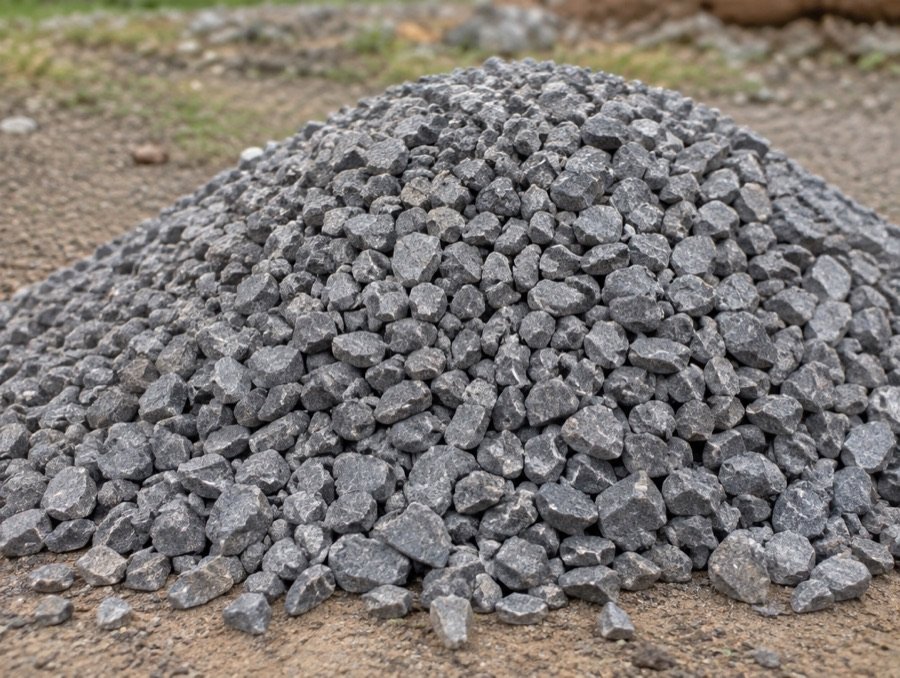
3/4 minus crushed stone is crushed rock with stones up to 3/4 inch plus the smaller sizes and dust. Oregon State Extension describes base material as crushed rock such as 3/4 minus, whose varied sizes and sharp edges make for easy compaction.
Road base, also sold as dense-grade aggregate, is a similar well-graded crushed product, usually with a larger top size. Penn State describes well-graded aggregates as dense mixtures with few air voids, preferred where compaction matters, such as road surfaces and fill. Wisconsin's road research center says granular base is typically dense graded, with more than 50 percent crushed coarse particles and fines capped at 8 percent. In practice, 3/4 minus and road base overlap heavily; they are not the same spec everywhere, so ask for the gradation.
Pea gravel is small, rounded, naturally worn stone. We found no official specification for it, but the sources describe the property that matters: University of Maine Extension notes that gravel, as opposed to crushed stone, is naturally eroded with smoother edges, and Vermont's driveway guidance says round stone should not be used as packing gravel.
Decorative river rock is larger rounded stone sold for looks. Our sources do not cover it separately; it behaves like other rounded stone and belongs on the surface, not in a base.
What to buy
Order by gradation and use, and compare delivered quantities rather than bag labels.
- For a base: angular crushed stone with fines (3/4 minus or dense grade). Ask if it is crushed and what percent passes the smallest sieve.
- For drainage: clean, washed, open-graded stone with little or no fines; ask for it by that description.
- For play areas: clean pea gravel or other loose-fill material, bought in enough volume for 12 inches of initial depth.
- For decoration: river rock or pea gravel in a color and size you like, in small bulk quantities.
- Fabric: woven polypropylene for weed barrier under paths (University of Maine), or filter fabric for trenches.
- A plate compactor suited to the lift thickness, sold or rented by force class.
- Edging in wood, stone or commercial products to keep gravel in place.
Preparing the site
Dig to the full depth of base, bedding and surface, with a slope away from buildings; Oregon State suggests a drop of 1 inch every 4 feet for paved areas. Compact the soil before adding stone. University of Maine's path recipe digs about 6 inches deep, adds 3 inches of compacted low-fertility sand, then fabric, then 3 inches of crushed stone or gravel screened to under 3/4 inch.
For a drainage trench, slope matters more than depth. Washington State University Extension gives 0.5 to 1 percent, or a drop of 1 foot over 100 feet for 1 percent, and describes the trench as lined with geotextile with perforated pipe surrounded by gravel.
Step by step: building a gravel base
This sequence works for a patio or walk base with crushed stone; adapt the stone and depth for other jobs.
- 1. Mark the area, excavate to depth and compact the soil.
- 2. Spread crushed stone with a little moisture in it; Oregon State notes moisture makes compaction much easier.
- 3. Place it in layers and compact each one. Oregon State suggests three smaller layers; ICPI gives minimum compacted lifts of 4 to 6 inches depending on equipment.
- 4. Check slope and level against your string line after each pass.
- 5. For pavers, add about 1 inch of bedding sand (ICPI), never substituting sand to fill dips in the base.
- 6. Install edge restraint before the surface material goes on.
- 7. For a path or play area, add the surface layer last and rake it level.
How deep and how to finish
Depth depends on the job, and the sources agree more than they differ:
- Patio or walk base: 4 to 6 inches compacted (ICPI, Oregon State), plus 1 inch of bedding sand under pavers.
- Driveway base: 6 to 8 inches (ICPI Tech Spec 10), thicker for soft soil or freezing; see our driveway depth guide.
- Path: about 3 inches of crushed stone or gravel over 3 inches of sand (University of Maine).
- Play area: 9 inches minimum compressed depth, starting at 12 inches; for pea gravel the table protects to a fall height of 5 feet, against 7 feet for wood mulch and 4 feet for sand (NDSU, citing CPSC).
- Drainage trench: enough stone to surround the pipe, wrapped in fabric, with soil over the top; WSU did not give a depth or stone size.
Common mistakes
- Using pea gravel as a base. It is rounded and tends to shift instead of locking.
- Using clean single-size stone where you need a firm surface. Penn State says open-graded aggregates drain well but do not compact into a dense mass.
- Using dense, fines-rich base in a trench where water must pass. Penn State says well-graded mixes are not suitable for drainage.
- Skipping lifts: Oregon State suggests dividing the base into three smaller layers and compacting between each.
- Not allowing for compaction when ordering.
- Letting topsoil or mulch wash into a drainage trench because the fabric was left off or was not wrapped over the top.
- Letting the play area drop below 9 inches as pea gravel is pushed aside.
Cost and ordering tips
We do not quote prices, but cost-per-job reasoning is straightforward. The base is the largest quantity on most jobs, so choosing the right base stone matters more than the surface. A rounded stone that has to be dug out and replaced costs far more in labor and material than the correct crushed stone the first time. Decorative stone is bought in small quantities because it only needs a thin surface layer, and a drainage trench needs only a modest volume of clean stone.
Ask suppliers for the gradation, whether it is crushed or rounded, whether it is washed, tons per cubic yard, and whether they sell by ton or yard. WSDOT notes that tabulated weights are dry and need correction for water content, so tons ordered by weight can differ from yards by moisture. One delivery of a base stone that you also use under a path may be more convenient than several small piles.
Maintenance and later top-ups
Rounded stone migrates. University of Maine notes that gravel rolls and moves more readily underfoot, so edging matters and you will rake displaced stone back. Replace lost depth in play areas, where NDSU notes compression and wear, and rake pushed-aside fill back under equipment. Crushed stone surfaces need occasional raking and a thin top-up. Drainage trenches need periodic inspection of the outlet and clearing of sediment.
Compaction and drainage compared
Angular, well-graded stone locks together when compacted and gets harder; it drains slowly because the voids between big pieces are filled with fines. Clean open-graded stone drains rapidly but stays loose. Rounded stone of one size does not interlock and moves under foot or wheels.
That trade-off is the whole decision. If the job needs strength, pick crushed stone with fines. If the job needs water to pass, pick clean stone. If the job needs a loose, soft or decorative surface, pick pea gravel or river rock.
Decision table: which gravel for which job
- Use: 3/4 minus crushed stone: patio, walkway or paver base. It compacts firmly in lifts (Oregon State, ICPI) and takes bedding sand.
- Use: 3/4 minus crushed stone: path surface over sand and fabric. University of Maine's recipe uses crushed stone screened under 3/4 inch, and it warns that gravel rolls and moves underfoot, so add edging.
- Use: road base (dense-grade aggregate) with 3/4 minus on top: driveway. Mixed sizes and fines pack into a hard surface, and Vermont warns against round stone.
- Use: clean washed open-graded stone: drainage trench. Open-graded aggregate drains well (Penn State) and the fabric keeps soil out (WSU).
- Use: pea gravel: play area. It is listed in the CPSC loose-fill table at 9 inches compressed depth for a fall height of 5 feet (NDSU).
- Use: decorative river rock: top dressing over fabric and a compacted base. It is rounded, so it will not carry load.
Common gravel project sizes
Each row uses the depth shown and includes 10% extra for waste. Change any number in the gravel calculator.
| Project | Depth | Cubic yards | Tons (typical) | 0.5 cu ft bags |
|---|---|---|---|---|
| 10x10 patio base | 4 in | 1.36 | 1.90 | 74 |
| 10x12 patio base | 4 in | 1.63 | 2.28 | 88 |
| 12x12 patio base | 4 in | 1.96 | 2.74 | order bulk |
| 12x16 patio base | 4 in | 2.61 | 3.65 | order bulk |
| 8x10 shed base | 4 in | 1.09 | 1.52 | 59 |
| 10x12 shed base | 4 in | 1.63 | 2.28 | 88 |
| 3x20 walkway | 3 in | 0.61 | 0.86 | 33 |
| 4x30 garden path | 3 in | 1.22 | 1.71 | 66 |
| 12x50 paver driveway base | 6 in | 12.22 | 17.11 | order bulk |
| 10x20 parking pad | 4 in | 2.72 | 3.80 | order bulk |
Frequently asked questions
Can I use pea gravel under pavers or a patio?
It is not recommended. Base stone should be crushed with varied sizes and sharp edges for easy compaction (Oregon State). Round, single-size pea gravel tends to shift instead of locking.
What is the difference between 3/4 minus and road base?
Both are crushed stone with fines. 3/4 minus has a top size of 3/4 inch. Road base or dense-grade aggregate is a similar well-graded product, often with a larger top size. Specifications vary by state, so ask for the gradation.
Is pea gravel good for a driveway?
Not as the main surface. Vermont's guidance says round stone should not be used as packing gravel, and the mix should include irregular crushed stone with fines.
What gravel is best for a drainage trench?
Clean, open-graded stone with little or no fines. Penn State says open-graded aggregates drain effectively. The trench should slope 0.5 to 1 percent and be lined with fabric (WSU).
How deep should pea gravel be on a playground?
At least 9 inches compressed, starting at 12 inches initial depth. For pea gravel the table protects to a fall height of 5 feet (NDSU, citing CPSC).
How much gravel do I need for a 10 by 10 foot patio base?
For a 4 inch compacted base, about 1.2 cubic yards compacted. Order about 1.5 to 1.6 cubic yards loose, roughly 2.4 to 2.5 tons with 10 percent waste.
Is river rock the same as pea gravel?
Both are rounded stone. River rock is usually larger and sold for decoration. Neither packs into a firm base.
Sources: Penn State Center for Dirt and Gravel Roads: Aggregates 101, Oregon State University Extension: 10-Step Guide to Installing Pavers, ICPI Tech Spec 10: Application Guide for Interlocking Concrete Pavements, University of Maine Cooperative Extension: Weed barrier and stone, NDSU Extension: Is Your Playground Safe for Kids?, WSU Clark County Extension: Improving Drainage, Vermont ANR Lake Wise: Crowned Driveways, Good Gravel, and Drainage Ditches, Wisconsin Rural Mobility Research Center: Granular Base. Read 7 November 2026.
What you will also need for gravel
Tools and supplies that go with this job. These are Amazon search links, so you can compare options and current prices there.
- Landscape fabric (weed barrier)
- Hand tamper or plate compactor
- Wheelbarrow
- Landscape edging
- Steel garden rake
- Work gloves
As an Amazon Associate I earn from qualifying purchases. These are paid links and cost you nothing extra.